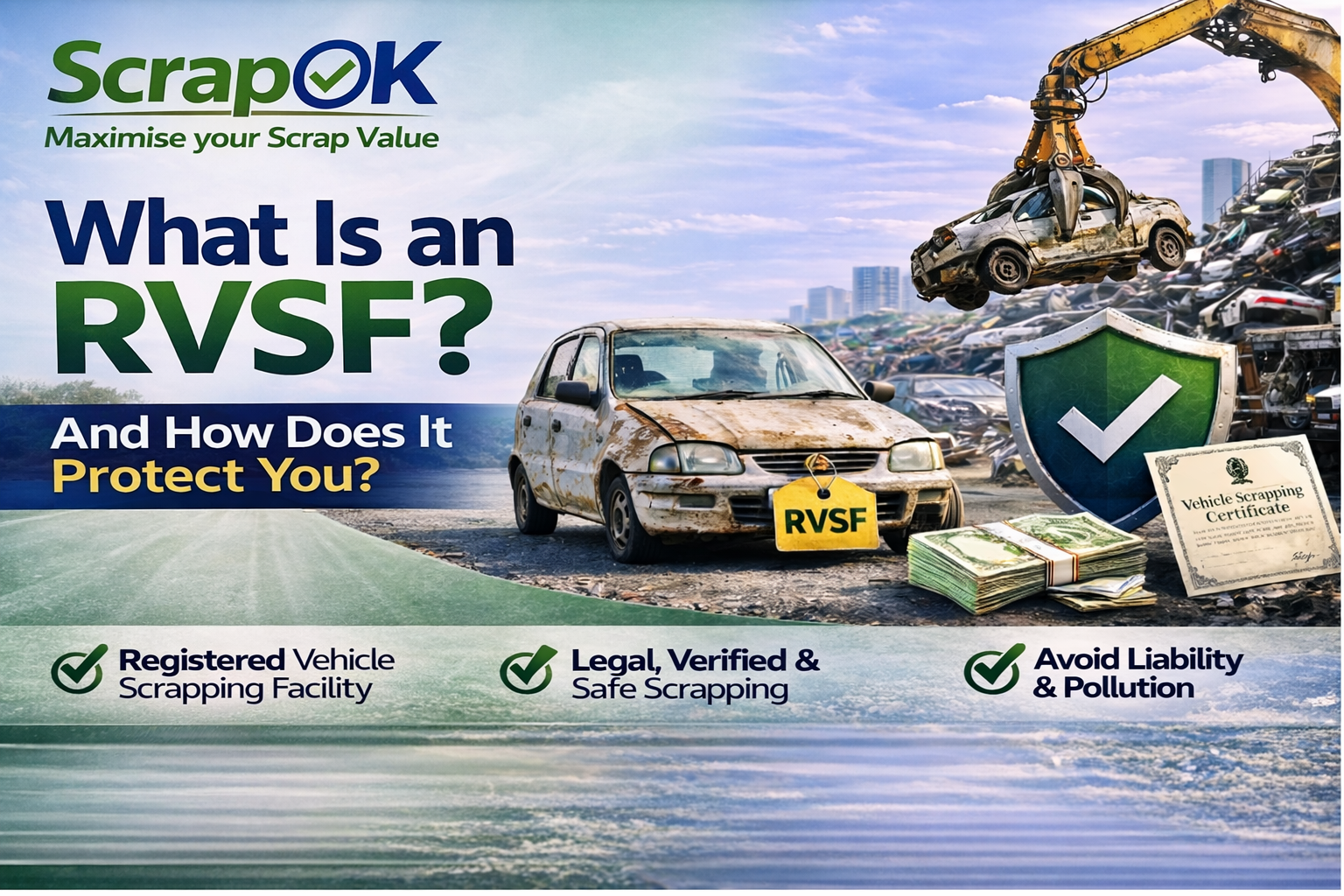
With India’s Vehicle Scrappage Policy gaining momentum, many vehicle owners are hearing the term RVSF for the first time. But what exactly is an RVSF, and why is it important when scrapping your old car?
If you’re planning to scrap an end-of-life vehicle (ELV), understanding the role of a Registered Vehicle Scrapping Facility (RVSF) is essential to protect yourself legally and financially.
This guide explains everything in simple terms.
What Is an RVSF?
RVSF stands for Registered Vehicle Scrapping Facility.
It is a government-authorized center approved to legally dismantle and scrap vehicles under India’s End-of-Life Vehicle (ELV) regulations.
Only facilities registered under the Ministry of Road Transport and Highways (MoRTH) can operate as official RVSFs.
Unlike informal scrap dealers, RVSFs:
- Follow environmental compliance norms
- Conduct safe depollution procedures
- Issue official Vehicle Scrapping Certificates
- Update records with the RTO
- Operate under structured documentation systems
In simple terms:
An RVSF ensures your vehicle’s final journey is legal, documented, and compliant.
Why Did India Introduce RVSFs?
India introduced RVSFs under the Vehicle Scrappage Policy to:
- Reduce pollution from old vehicles
- Promote safe metal recycling
- Prevent illegal resale of scrapped vehicles
- Digitally track vehicle deregistration
- Improve road safety
Earlier, vehicles were often scrapped in unregulated yards, leading to environmental damage and legal risks for owners.
RVSFs solve that problem.
How Does an RVSF Protect You?
This is where it gets important.
When you scrap your vehicle through an authorized RVSF, you are protected in multiple ways:
1. Protection from Legal Liability
If a vehicle is scrapped illegally and later misused, the original owner may still appear responsible in RTO records.
An RVSF ensures:
- Proper deregistration
- Permanent cancellation of the RC
- Removal from government records
That means no future challans, no misuse, and no liability risk.
2. Official Vehicle Scrapping Certificate
After dismantling, the RVSF issues a Vehicle Scrapping Certificate.
This document:
- Confirms legal scrapping
- Serves as proof of destruction
- Helps in deregistering the vehicle
- Can be used for incentives under scrappage policy
Without this certificate, you have no formal proof that your vehicle was scrapped.
3. Environmentally Safe Disposal
RVSFs follow structured depollution processes:
- Removal of oils and fluids
- Safe battery disposal
- Controlled dismantling
- Scientific metal shredding
This reduces environmental hazards and ensures sustainable recycling.
4. Transparent Valuation
Authorized RVSFs typically base scrap value on:
- Vehicle weight
- Metal scrap rates
- Condition of reusable parts
- Market pricing
This reduces arbitrary pricing often seen in local scrap markets.
5. Secure Documentation Process
RVSFs require proper documentation such as:
- Original RC (or affidavit if lost)
- Owner ID proof
- PAN card
- Bank details
- Self-declaration
This documentation protects both the owner and the facility.
What Happens at an RVSF?
Here’s the general process:
- Vehicle verification
- Document submission
- Vehicle pickup or drop-off
- Depollution process
- Dismantling and metal shredding
- Certificate issuance
- RTO record update
The entire system is structured and traceable.
RVSF vs Local Scrap Dealer: What’s the Difference?
| Feature | RVSF | Local Scrap Dealer |
|---|---|---|
| Government Authorized | Yes | No |
| Legal Certificate Issued | Yes | Rarely |
| RTO Deregistration | Structured | Often ignored |
| Environmental Compliance | Mandatory | Unregulated |
| Documentation Process | Proper | Minimal |
If your priority is legal safety and compliance, RVSF is the correct route.
Do You Need to Contact an RVSF Directly?
Not necessarily.
Many vehicle owners struggle with:
- Identifying genuine RVSFs
- Comparing scrap value quotes
- Handling paperwork
- Coordinating pickup
This is where a professional consultant can help compare verified RVSF options and ensure you get the best possible value while staying compliant.
Common Misconceptions About RVSFs
❌ “Any scrap yard can issue a certificate.”
No. Only registered RVSFs can issue valid scrapping certificates.
❌ “RC cancellation happens automatically.”
It must be formally processed through documentation.
❌ “Scrap value is the same everywhere.”
Rates vary significantly between facilities.
How to Verify If a Facility Is an RVSF
You can:
- Check government-approved listings
- Verify registration details
- Ask for official certification proof
- Confirm RTO integration
Never rely only on verbal assurance.
Final Thoughts
An RVSF is not just a scrapyard. It is a regulated facility designed to protect vehicle owners, the environment, and public safety.
If you are planning to scrap your vehicle, ensure it is done through a government-authorized RVSF and complete the deregistration process properly.
Legal scrapping protects you from future liabilities and ensures you receive verified value for your end-of-life vehicle.

